Address
304 North Cardinal St.
Dorchester Center, MA 02124
Work Hours
Monday to Friday: 7AM - 7PM
Weekend: 10AM - 5PM

Address
304 North Cardinal St.
Dorchester Center, MA 02124
Work Hours
Monday to Friday: 7AM - 7PM
Weekend: 10AM - 5PM
Why Your Organization Is Being Outpaced by Its Own Machines
Author: Dave Gajadhar
If AI is the engine, your human system is the transmission — and right now, most organizations are stuck in first gear.
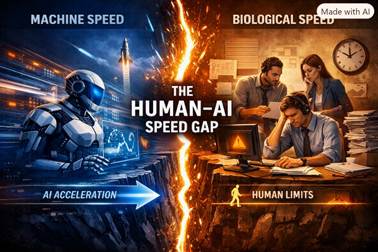
AI Is Accelerating. Humans Aren’t.
Across planning, dispatch, maintenance, safety, logistics, and workforce management, AI is moving at machine speed. But human systems — skills, judgment, governance, culture — are still operating at biological speed.
AI isn’t your bottleneck — your human operating system is. DG
This widening speed gap is becoming the defining strategic tension of the next decade. And the organizations that ignore it will be outpaced by the very tools they deploy.
The Human–AI Alignment Blueprint
Synchronizing human capability with AI‑accelerated value chains.
Most organizations think they’re “implementing AI.” They’re only upgrading the machinery — not the humans who must operate, supervise, and govern it.
Here’s what alignment requires:
1️⃣ Skills Alignment: The New Competency Currency
AI‑critical skills — data reasoning, agent supervision, workflow orchestration — are now essential. Competency models must update quarterly, not annually.
If your skills strategy updates slower than your software, you’re already behind. DG
And yes — skill decay is real. When AI does the thinking, human judgment atrophies. You must monitor it.
2️⃣ Role Alignment: The New Workforce Architecture
Roles must be recomposed into:
Plus, new roles built for the AI era:
Stop asking, “Who does this task?” Start asking “Who should — the human or the machine?” DG
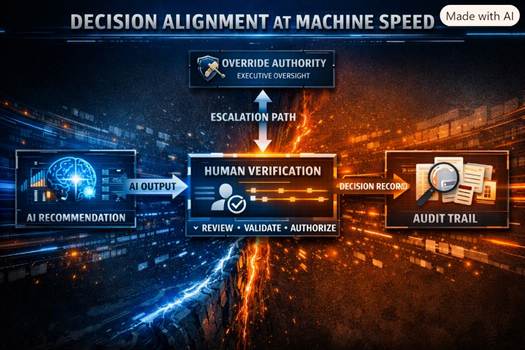
3️⃣ Decision Alignment: Clarity at Machine Speed
However, every operational decision must map to:
Ambiguity is the enemy of safety — especially when machines move faster than humans can think. DG
4️⃣ Governance Alignment: Accountability Without Confusion
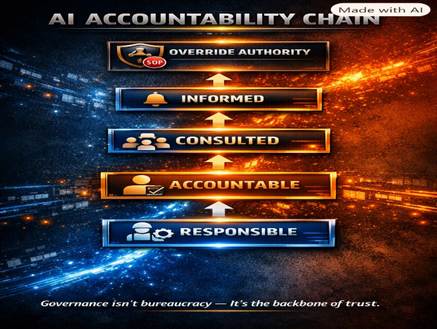
AI accountability chains must be explicit:
Responsible → Accountable → Consulted → Informed → Override Authority
Plus, AI safety cases, audit loops, and verification capacity.
Because, if everyone owns AI outputs, no one owns AI outputs. DG
5️⃣ Culture Alignment: Trust Is a Design Choice
Shift from “AI replaces tasks” to “AI amplifies capability.”
Build trust through:
| • Transparency dashboards |
| • Human in the loop rituals |
| • Clear escalation pathways |
For Example, Culture is the operating system that determines whether AI becomes a superpower or a threat. DG
The C‑Suite Risk Briefing: What Happens When AI Outpaces Humans
Executives must understand the eight risks emerging right now:
| 1. Workforce Overcapacity + AI Skill Shortages – Legacy roles shrink while AI critical roles remain unfilled. |
| 2. Skill Atrophy – Automation erodes human judgment pipelines. |
| 3. Governance Gaps – AI outputs lack clear ownership and escalation. |
| 4. Operational Drift – AI makes decisions humans cannot interpret or verify. |
| 5. Cultural Resistance – Fear, ambiguity, and misaligned incentives slow adoption. |
| 6. Hidden Workforce Costs – Short skill cycles and premium AI talent reshape budgets. |
| 7. AI Agent Failure Modes – Not technical failures — organizational failures. |
| 8. Strategic Value Leakage – AI creates value the organization cannot capture. |
AI doesn’t fail because it’s weak — it fails because your organization is. DG
The Human–AI Operating Model: Your New Organizational Backbone
This is the system that synchronizes machine speed with human judgment.
| Roles – Human Critical → AI Augmentable → AI Automatable → New AI Era Roles |
| Workflows – AI recommendation → human verification → decision rights → escalation → override → audit trail |
| Governance – Accountability chains, safety cases, monitoring loops. |
| Culture – Transparency, trust, continuous learning, shared ownership. |
If your workflows aren’t designed for AI, your outcomes won’t be either. DG
The Executive Imperative
The message leaders must internalize:
AI is not the transformation. The transformation is redesigning the human system to work with AI.
To win the next decade, leaders must:
| • Recompose roles | • Rebuild skills |
| • Redesign workflows | • Reengineer governance |
| • Re-anchor culture | • Reinvent leadership |
This isn’t incremental — it’s existential. DG
Call to Action
Organizations that thrive will be the ones that align human judgment, governance, and culture to the speed of AI.
Those that don’t will be outpaced by their own machines.
The future belongs to leaders who upgrade humans as aggressively as they deploy AI. DG
Subscribe for more contrarian articles by Dave Gajadhar:
