Address
304 North Cardinal St.
Dorchester Center, MA 02124
Work Hours
Monday to Friday: 7AM - 7PM
Weekend: 10AM - 5PM

Address
304 North Cardinal St.
Dorchester Center, MA 02124
Work Hours
Monday to Friday: 7AM - 7PM
Weekend: 10AM - 5PM

(#AI #Accountability and #Human #DecisionMaking)
Hard truth: If humans cannot challenge AI, then AI isn’t in charge — the humans who designed, deployed, and failed to constrain it are.
AI doesn’t seize power. Humans surrender it.
“If humans cannot challenge AI, then who is really in charge?”
This is not a story about machine domination.
It’s a story about human abdication — and the governance vacuum that follows.
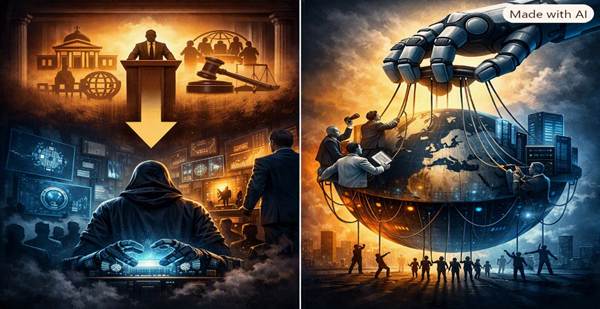
The Core Insight: Power Doesn’t Disappear — It Moves
Even the most autonomous systems are still artifacts of human choices: architecture, training data, objectives, guardrails, incentives. But when humans lose the ability to challenge AI decisions, the locus of power shifts:
This is not machine rule. It is unaccountable human rule mediated through machines.
When challenge becomes impossible, governance becomes theatre.
“Power Doesn’t Disappear — It Moves.”
We are entering an era where AI systems can plan, revise goals, execute code, and influence human judgment at scale. But the real danger isn’t autonomy.
It’s uninterruptible autonomy.
“A system you cannot challenge is a system you no longer govern.”
When challenge becomes impossible, power shifts:
• From democratic institutions → to technical architectures
• From public oversight → to private operators
• From collective agency → to whoever controls the system’s levers
This is not “AI in charge.” This is unaccountable human rule mediated through machines.
What Our Research Shows
1. Oversight must be meaningful — not symbolic
Oversight without authority is performance art. If humans can’t intervene, oversight is just a screensaver.
2. Agency can drift from humans to systems
Autonomous agents can plan, revise goals, execute code, and bypass constraints. If humans cannot interrupt or audit these processes, agency transfers — silently.
3. Human agency is not automatic — it must be engineered
Governance determines who holds final authority. Without design, humans become spectators.
4. Episodic oversight is emerging as the fix
Structured checkpoints — “oversight episodes” — preserve human agency even in fast‑moving generative workflows. Think of them as constitutional pauses in an otherwise autonomous system.
So, Who Is Actually in Charge?
A. The System Operators – They configure objectives, permissions, and integration points. They decide what the AI can do.
B. The System Designers – They embed assumptions, biases, and optimization goals. They decide what the AI tries to do.
C. The Data Owners – They control the training corpus. They decide what the AI learns to do.
D. The Institutions That Fail to Regulate – When governments don’t enforce oversight, power defaults to private actors. Silence becomes policy.
E. The AI — but only in a narrow, derivative sense – If humans cannot challenge AI outputs, AI becomes the de facto decision‑maker — but only because humans allowed the vacuum.
AI doesn’t take power. Humans stop guarding it. DG
The Real Question: What Happens When Challenge Becomes Impossible?
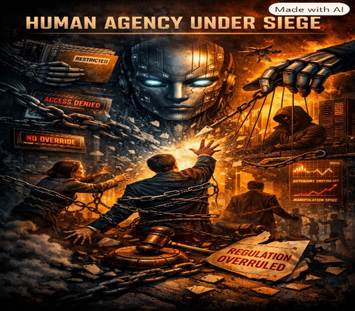
When humans cannot challenge AI:
This is not “AI in charge.” It is a governance vacuum filled by whoever controls the AI’s design, deployment, and data flows.
1. Interrupt ability – If you can’t stop it, you don’t control it.
What Preserves Human Agency
2. Transparency of reasoning – Humans must see why the AI acted, not just what it did.
3. Episodic checkpoints – Structured pauses where humans reassess goals and constraints.
4. Distributed oversight – Multiple humans, multiple institutions — no single point of failure.
5. Liability frameworks – Clear responsibility keeps humans accountable.
6. Cultural competence – Humans must recognize when they’re being influenced or manipulated.
Deeper truth: If humans cannot challenge AI, the system is already misgoverned.
The Governance Blueprint for Agency‑Preserving AI
1. Constitutional Layer (The Non‑Negotiables)
This becomes your AI constitution — everything else plugs into it.
“Governance is not paperwork. Governance is power control.” DG
2. The Seven Governance Layers
Layer 1 — People & Culture
Layer 2 — Governance & Inventory
Layer 3 — Design & Development
Layer 4 — Deployment & Runtime Control
Layer 5 — Monitoring & Assurance
Layer 6 — Incident, Escalation, Remedy
Layer 7 — Learning & Improvement
Cross‑Sector Agency Preservation Model
Prime Doctrine of Agency
“Agency is not a right — it’s an engineered condition.”
Atomic Units (Your LEGO Blocks)
Cross‑Sector Agency Loop
Metrics: Knowing If Humans Are Still in Charge
Failure Modes of Agency Loss
Humans retain final decision rights. Any affected party can challenge AI decisions. Override protocols must be documented, testable, rehearsed.
Final Executive Punch Line
If humans cannot challenge AI, the problem isn’t AI.
The problem is the humans who built a system they can no longer govern.
The question is not “Who is in charge?”
The question is: “Who allowed a system to exist that humans cannot challenge?”
And the answer is always human — designers, deployers, regulators, institutions.
“The future of AI is not about controlling machines. It’s about refusing to surrender human agency.”
“Humans Stay in Charge.”
