Address
304 North Cardinal St.
Dorchester Center, MA 02124
Work Hours
Monday to Friday: 7AM - 7PM
Weekend: 10AM - 5PM

Address
304 North Cardinal St.
Dorchester Center, MA 02124
Work Hours
Monday to Friday: 7AM - 7PM
Weekend: 10AM - 5PM

Focus must be on Human Accountability and Capability, not at full machine capacity
Our governance‑centric look at how AI oversight should prioritize empowerment, literacy, and equitable access.
Author: Dave Gajadhar
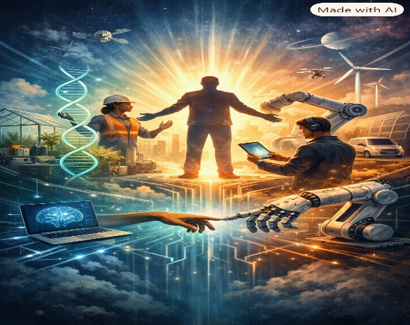
However, Humanity is entering a decade where AI, bio‑technologies, automation, and robotics will reshape every regulated industry—from water and aviation to agriculture, energy, health, and finance. But the real story isn’t about machines becoming more capable; it’s about people becoming more empowered.
For example, leaders, today we stand at the edge of a decade where AI, bio‑technologies, automation, and robotics will transform every regulated industry we depend on: water, aviation, agriculture, energy, health, finance, transportation, and food systems.
But let me begin with a simple truth:
Because Humanity stands at the threshold of a profound technological inflection point. Artificial intelligence, bio‑technologies, automation, and robotics are accelerating into every regulated industry—water, aviation, agriculture, energy, health, finance, transportation, and food systems. These tools promise singular capability, but capability alone is not progress.
Because the true measure of our technological advancement is not how powerful our machines become; it is how much more empowered our people become. The next decade demands a deliberate shift from automation‑first thinking to empowerment‑first governance. Technology must not become the privilege of the few—it must become the servant of humanity, strengthening the hands, judgment, and dignity of the many.
“2035 governance agenda where human agency, safety, equity, and transparency are non‑negotiable. Regulated industries must evolve into human‑centered autonomous ecosystems—systems where machines sense, predict, and optimize, but humans govern consequence, ethics, and societal impact. We must embed human‑centric impact tests into every deployment, ensure that critical decisions remain under human authority, and build shared digital infrastructures that democratize access rather than concentrate power. The future we choose will be defined not by the sophistication of our technologies, but by the strength, capability, and empowerment of the people who use them.” DG
The true measure of technological progress is not how powerful our machines become. It is how much more empowered our people become.
For too long, the global narrative has been obsessed with capability—faster algorithms, smarter robots, more autonomous systems. But capability without empowerment is not progress. It is concentration. It is exclusion. It is fragility disguised as innovation.
The future we must build is different.
The future we must build is human‑centered.
The future we must build is governed.
The defining question of 2035 is simple:
Does technology expand human judgment, dignity, safety, and opportunity—or does it concentrate power in the hands of a few?
The future we choose depends on how deliberately we embed human‑centric governance into every system we build.
Technology must not become a privilege reserved for elite institutions, major corporations, or specialized operators.
It must become a public good, a shared capability, and a force multiplier for workers, communities, and citizens.
When deployed with intention, AI and automation can elevate human roles, democratize access, strengthen safety, and create transparency across all regulated sectors.
When misaligned, they risk eroding trust, widening inequities, and diminishing human agency. The next decade is our chance to ensure technology becomes the servant of humanity, not its sovereign.
“Powerful technology means nothing if people aren’t empowered.” DG
THE CORE DOCTRINE — TECHNOLOGY MUST SERVE HUMANITY
Here is the doctrine that will define the next decade:
Technology must not become the privilege of the few. It must become the servant of humanity.
This is not a slogan. This is a governance imperative.
If AI replaces human judgment, we lose trust.
If automation replaces human dignity, we lose stability.
If bio‑tech replaces human sovereignty, we lose legitimacy.
The systems we build must amplify human capability, not diminish it.
They must widen access, not narrow it.
They must strengthen communities, not bypass them.
THE HUMAN–MACHINE–HUMAN MODEL (HMH)
Across all regulated industries, one operating model will define the future:
Machine senses → Human interprets → Machine executes → Human reviews.
This is the Human–Machine–Human loop.
Machines bring speed, scale, and precision. Humans bring judgment, ethics, and consequence awareness. Together, they create resilience.
“The future isn’t human vs. machine. It’s human with machine.” DG
WHY THIS MATTERS — THE GLOBAL PRESSURES
We are entering a decade shaped by:
These pressures demand a governance shift. Automation‑first thinking cannot meet these challenges. Empowerment‑first governance can.
“If technology doesn’t widen access, it widens inequality.” DG
THE GOVERNANCE ARCHITECTURE FOR 2035
Across water, aviation, agriculture, and every regulated sector, governance must embed five pillars:
Human Agency – Critical decisions must remain under human authority. Override paths must be clear, logged, and enforceable.
Safety & Reliability – Hybrid oversight must reduce incidents, errors, and downtime. Fail‑safes must default to human control.
Equity & Access – Technology must widen access to essential services. No community should be left behind by digital transformation.
Transparency & Contestability – Automated decisions must be explainable, reviewable, and challengeable. Opacity is a risk multiplier.
Workforce Capability – Automation must include funded reskilling and new hybrid roles. Robotics must elevate labor dignity, not erase livelihoods.
Empowered people create resilient industries.
SECTOR EXAMPLES — WATER, AVIATION, AGRICULTURE
WATER — Human‑Centered Autonomy – Water utilities deploy digital twins, robotics, and AI forecasting. But operators remain in command. Communities gain visibility through public dashboards. Allocation decisions become transparent and contestable.
Water autonomy must strengthen operators and communities—not bypass them.
AVIATION — Hybrid Autonomy – AI co‑pilots support pilots with predictive routing and risk alerts. Towers use AI for conflict prediction. Maintenance becomes predictive but always human‑validated. Safety‑critical decisions remain human‑controlled.
“Human judgment is the ultimate safety system.” DG
AGRICULTURE — Precision with Sovereignty – Farmers own their data. AI provides decision support, not command. Robotics remove drudgery and elevate labor dignity. Agronomic models are co‑created with farmer feedback.
Technology must strengthen the farmer—not replace them.
THE CROSS‑SECTOR IMPERATIVE
Across all regulated industries, the governance mandate is clear:
Powerful technology means nothing if people aren’t empowered.
“Automation should lift humans up—not push them out.” DG
“The future isn’t human vs. machine; it’s human with machine.” DG
It is how much more empowered our people become.
Technology, must not become the privilege of the few, it must become the servant of humanity.
How will this concept roll out across ALL regulated industries to 2035?
We are putting the finger on the real question: not what we build, but who it serves? DG
Core principle: technology as a servant, not a sovereign
To 2035, across regulated industries (finance, health, energy, water, transport, food, aviation, etc.), this concept translates into one anchor:
Every deployment of AI, bio‑tech, automation, and robotics must be judged by net human empowerment, not technical sophistication.
That means regulators, boards, and operators stop asking “Can we?” and start hard‑coding “Does this expand human capability, dignity, safety, and inclusion?”
Regulatory architecture: embedding human‑centric tests
Human‑centric impact tests: By 2035, regulated industries will increasingly require “human impact assessments” alongside safety and financial risk assessments—formal tests of:
Duty of human oversight: Regulations will codify those critical decisions—liberty, health, safety, financial ruin, environmental harm—must retain meaningful human review, with clear lines of accountability when machines are involved.
Standards and audits: Sector‑specific standards (like “human‑centric AI” and “Industry 5.0” frameworks) will push regular audits on explainability, bias, safety, and worker impact, not just technical performance.
Workforce: from replacement to augmentation
Co‑pilot, not auto‑pilot: Automation and robotics will be framed as assistive systems—co‑pilots for clinicians, operators, controllers, inspectors—rather than silent replacements. The measure of success becomes: how much more capable, accurate, and safe the human team becomes.
Continuous reskilling contracts: Regulated industries will move toward binding commitments: if automation is introduced, funded reskilling and redeployment pathways must follow. No “tech upgrade” without a “human upgrade.”
New roles of stewardship: We’ll see growth in roles like AI safety officers, data stewards, algorithmic auditors, and human‑machine interaction designers—people whose job is explicitly to keep technology aligned with human values and regulatory obligations.
Access and inclusion: avoiding “privilege of the few”
Universal service in a digital age: Regulators will extend “universal service” concepts (like in telecoms and utilities) to digital and automated systems: essential AI‑enabled services must be accessible, affordable, and usable by all, not gated behind premium tiers or exclusive platforms.
Design for the margins: Human‑centric design will require systems to work for people with low digital literacy, disabilities, language barriers, or limited connectivity. If a system only works well for the already‑empowered, it fails the empowerment test.
Public infrastructure for tech: Expect more public or cooperative platforms—shared data spaces, open standards, public AI utilities—so that smaller actors and communities can benefit, not just large incumbents.
Governance: multi‑stakeholder, not tech‑elite
Shared governance tables: By 2035, credible governance in regulated industries will involve regulators, operators, workers, civil society, and affected communities in decisions about AI and automation—not just vendors and executives. Global initiatives are already pushing this “for humanity” framing.
Transparency obligations: Systems that materially affect rights or safety will need clear documentation: what data they use, how they decide, how errors are handled, and how people can challenge or appeal outcomes.
Red lines and no‑go zones: Some uses will be explicitly prohibited where empowerment cannot be guaranteed—e.g., opaque systems making unreviewable decisions about liberty, health, or survival.
Sector examples to 2035
Health and bio‑technologies:
Finance and insurance:
Energy, water, and critical infrastructure:
Transport and aviation:
What “empowered people” will look like in 2035
If this concept is taken seriously, by 2035 in regulated industries you’d expect:
“If technology doesn’t widen access, it widens inequality.” DG
“Human judgment is the ultimate safety system.” DG

We are essentially arguing for a simple litmus test:
“If tech is a servant, what does that actually look like in the control room, the cockpit, and the field by 2035?”
Examples:
| Water: human empowering governance and operations to 2035 | Governance moves Human centric service mandates: Label: Access & equity rules: Regulators tie digital water systems (smart meters, reuse plants, desalination, AI leak detection) to obligations on affordability, transparency, and appeal rights for households and farmers.Algorithmic accountability in utilities: Label: Explainable decisions: Any automated decision that affects billing, disconnection, allocation, or reuse permits must be explainable, logged, and reviewable by a human officer.Participatory basin governance: Label: Shared data spaces: River basin and aquifer authorities build shared data platforms where communities, indigenous groups, farmers, and utilities can see and question models used for allocation and drought planning. |
| Operating practices Operator in the loop control rooms: Label: Co pilot SCADA: AI forecasts and digital twins propose actions (valve changes, pressure adjustments, reuse routing), but certified human operators approve, override, and learn from them.Empowered field technicians: Label: Augmented maintenance: Technicians use AR, robotics, and AI diagnostics to find leaks and failures faster—paired with training so they become system stewards, not button pushers.Community facing dashboards: Label: Radical transparency: Public dashboards show water quality, outages, reuse flows, and major automated decisions in plain language, with channels for challenge and feedback. | |
| Aviation: human empowering governance and operations to 2035 | Governance moves Human responsibility in hybrid autonomy: Label: Clear accountability lines: Regulations define which decisions must remain human—flight safety, emergency response, airspace changes—even when AI and automation are deeply embedded.Certification for human machine teaming: Label: New licensing standards: Pilots, controllers, and maintenance crews are certified not just on aircraft, but on human machine collaboration—how to supervise, question, and override automated systems.Incident investigation that includes algorithms: Label: Joint forensics: Safety boards treat algorithms as “participants” in incidents: logs, training data, and model behavior are examined alongside human actions. |
| Operating practices Cockpit and tower as augmented decision hubs: Label: Co pilot AI: AI suggests routes, conflict resolutions, and risk alerts; humans remain final decision makers, with interfaces designed to keep situational awareness, not erode it.Maintenance as data driven craft, not blind automation: Label: Predictive + human judgment: Predictive maintenance flags issues; licensed engineers validate, investigate edge cases, and feed back real-world findings to improve models.Passenger facing transparency: Label: Trust by design: Airlines explain where automation is used (routing, scheduling, safety systems), what humans still control, and how safety is governed—turning tech from mystery into reassurance. | |
| Agriculture: human‑empowering governance and operations to 2035 | Governance moves Farmer data rights and bargaining power: Label: Data sovereignty: Rules ensure farmers own or co‑own their data from sensors, drones, and platforms, with rights to portability, fair contracts, and collective bargaining.Inclusive innovation standards: Label: Smallholder lens: Public funding and regulation prioritize tools that work for small and mid‑scale producers, not just mega‑farms—low‑cost robotics, shared platforms, co‑ops.Bio‑tech with consent and benefit‑sharing: Label: Ethical genetics: Gene‑edited crops and bio‑inputs are governed by clear consent, traceability, and fair value‑sharing with communities and origin ecosystems. |
| Operating practices Farmer‑in‑command precision systems: Label: Decision support, not diktat: AI recommends planting dates, irrigation, and inputs; farmers see the rationale, adjust for local knowledge, and retain final say. Robotics as labor dignity tools: Label: From drudgery to skill: Robots take on repetitive, hazardous tasks (weeding, spraying, heavy lifting), while workers are trained into higher‑skill roles—robot supervisors, data interpreters, soil stewards. Local knowledge embedded in models: Label: Co‑created algorithms: Agronomic models are iteratively tuned with farmer feedback—what worked, what failed—so tech learns from lived practice, not just lab data. |
Cross‑sector 2035 litmus test
By 2035, in water, aviation, and agriculture, this empowerment lens shows up as:
“2035 Human‑Machine‑Human Blueprint” — a cross‑sector summary.
“Transparency builds trust; opacity builds risk, Empowered people create resilient industries.” DG
“The future is human‑centered autonomy.” DG
2035 VISION
Leaders, the future we are building is not a future of machines.
It is a future of empowered people supported by intelligent systems.
A future where:
Water systems are transparent and community‑governed
Aviation systems are safer because humans and machines collaborate
Agriculture systems are more resilient because farmers retain sovereignty
Digital infrastructure is a public good
Technology amplifies human capability across every sector
The governance vision of 2035. The future will be automated—but leadership will always be human.
“Technology must serve the many, not the few, Technology must serve humanity, not replace it.” DG
THE CALL TO ACTION
The next decade is not about technology.
It is about control. Control of risk. Control of consequence. Control of the systems that shape our societies.
Your role as leaders is not to adopt technology blindly.
Your role is to govern it wisely. To ensure that every system we build—every AI, every robot, every bio‑tech innovation—serves humanity, strengthens communities, and empowers people.
This is our mandate.
This is our moment.
This is the future we must lead.
